
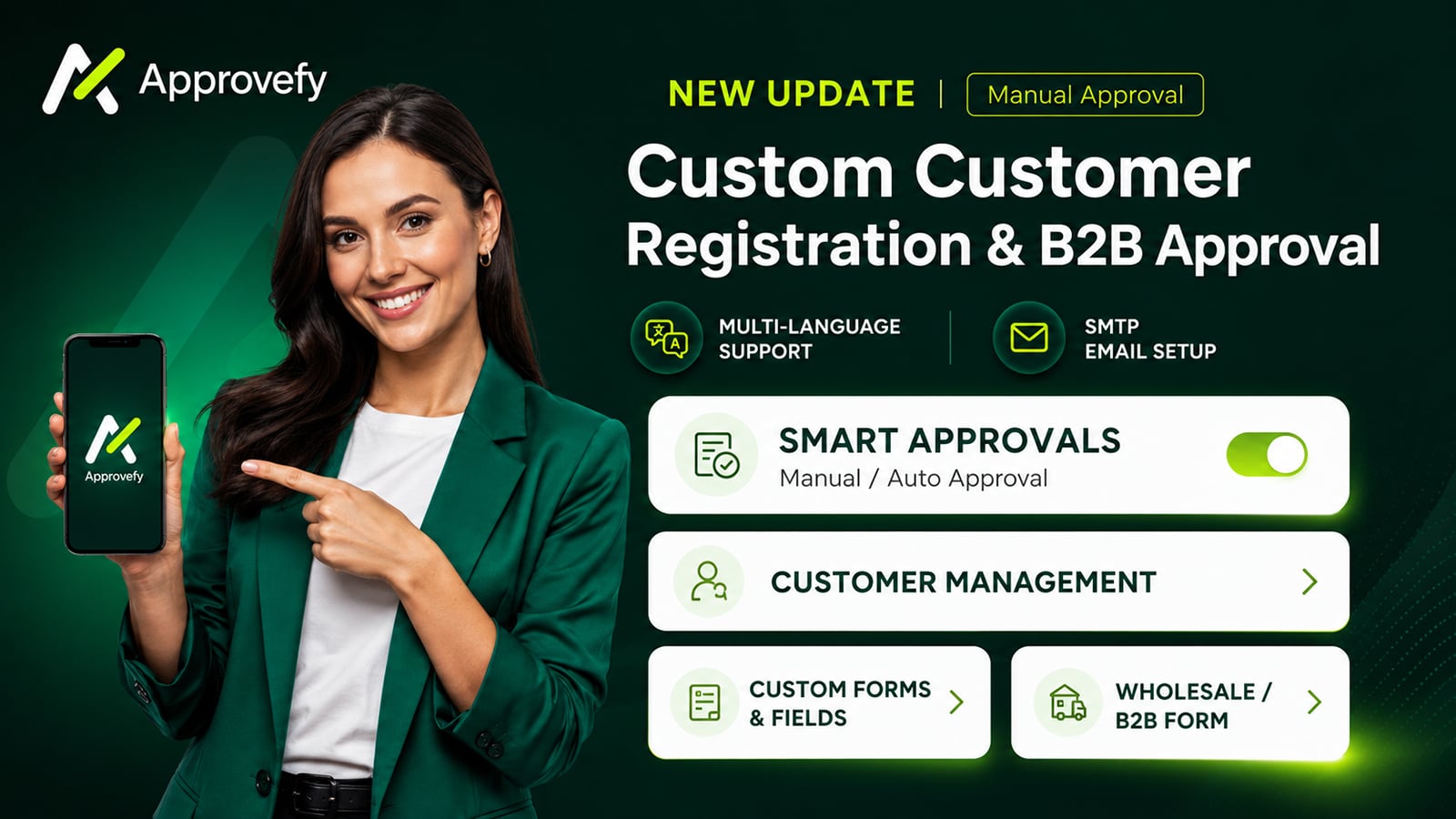
Shopify is changing the way customer accounts work.
On February 26, 2026, Shopify officially deprecated Legacy Customer Accounts. Legacy accounts are no longer available to new Shopify stores or existing stores that were not already using them, and Shopify has confirmed that merchants should move toward the latest Customer Accounts experience.
For many standard B2C stores, this transition may be straightforward.
But for B2B, wholesale, distributor, dealer, and reseller stores, customer registration is often much more complicated.
A business customer may need to provide:
First and last name
Email address
Phone number
Company name
Business address
VAT or tax information
Company registration details
Customer type
Distributor or reseller information
Additional custom business details
This is where Approvefy provides a more flexible B2B registration and approval workflow for Shopify.
Why Shopify's Legacy Customer Account Change Matters
Traditional Shopify themes could use legacy customer account templates to create and customize parts of the customer registration experience.
With Shopify moving away from Legacy Customer Accounts, merchants and developers should no longer build new registration workflows that depend on those old Liquid customer account templates.
Shopify has also stated that Legacy Customer Accounts will no longer receive feature updates or technical support, with a final sunset date expected to be announced separately.
For businesses using Shopify for wholesale or B2B sales, this creates an important question:
How do you collect detailed company information from new B2B customers without depending on the old legacy registration system?
Approvefy is designed to solve this problem.
Build a Dedicated B2B Registration Form with Approvefy
Approvefy allows Shopify merchants to create a dedicated registration experience specifically for their business customers.
Instead of being restricted to a basic customer registration form, merchants can collect the information they actually need before approving a business customer.
For example, an Approvefy B2B registration form can collect:
Customer Information
Name, email address, telephone number and other customer details.
Company Information
Company name, business information, addresses and other relevant company details.
Custom Fields
Stores can add additional fields depending on their wholesale or B2B requirements.
This means a merchant can create a registration workflow that matches the way their business actually operates.
From Registration Form to Shopify B2B Company
Shopify's B2B architecture is built around Companies, Company Locations and Company Contacts.
A Shopify Company represents the business buying from the merchant. A company can contain contacts and one or more locations, allowing Shopify to support more advanced B2B relationships.
Approvefy can use the information collected through its B2B registration workflow to help create and manage the appropriate B2B customer and company records inside Shopify.
Instead of collecting only a basic customer account, the registration process can be structured around the business itself.
For example:
Customer submits Approvefy form → Business information is collected → Merchant approval workflow runs → Shopify B2B customer/company information is created or connected.
This creates a much more appropriate onboarding process for wholesale customers.
Approve B2B Customers Before Giving Access
Not every business that submits a registration form should automatically receive wholesale access.
Many B2B merchants need to verify a customer first.
Approvefy provides a customer approval workflow that allows merchants to review registrations before giving customers the appropriate access.
A typical workflow could be:
A business visits the Shopify store.
The customer opens the Approvefy B2B registration form.
They submit their contact and company information.
The registration appears in the merchant's Approvefy admin.
The merchant reviews the application.
The customer is approved or rejected.
Approved customers can then continue through the appropriate B2B purchasing experience.
This gives merchants much more control over who becomes a wholesale customer.
No Dependency on Legacy Registration Templates
One of the most important advantages of this approach is that the B2B registration experience doesn't have to depend on Shopify's old Legacy Customer Account registration templates.
Approvefy provides its own dedicated registration workflow for collecting and processing B2B applications.
That makes it possible to build a modern B2B onboarding experience while Shopify continues moving merchants toward its latest Customer Accounts architecture.
This should not be viewed as bypassing Shopify's security or platform rules.
Instead, Approvefy provides an alternative registration workflow built around Shopify's current APIs and B2B architecture rather than relying on deprecated legacy account templates.
Designed for Real B2B Registration Requirements
A typical B2C customer registration process may only require an email address and basic customer information.
B2B onboarding is different.
A wholesale supplier might need to know:
Which company the customer represents
Their contact information
Their business address
Whether they are a retailer, distributor or reseller
Tax or VAT information
Which market they operate in
Whether they meet wholesale requirements
Approvefy gives merchants the flexibility to build registration forms around these requirements instead of forcing every business into the same basic registration process.
Shopify B2B Is Built Around Companies
Shopify's current B2B APIs provide resources for creating and managing Companies, Company Contacts and Company Locations.
Company Locations can also support different billing and shipping addresses, catalogs, pricing, payment terms, tax configurations and other B2B-specific settings.
This architecture makes the company—not simply an individual customer account—an important part of Shopify B2B.
Approvefy's B2B registration approach complements this structure by collecting company information from the beginning of the onboarding process.
Who Can Benefit from Approvefy?
Approvefy can be useful for Shopify stores operating as:
B2B wholesalers
Distributors
Dealers
Resellers
Manufacturers
Suppliers
Trade-only stores
Retailer networks
B2B + B2C hybrid stores
Instead of manually collecting business information through emails or generic contact forms, merchants can create a structured registration and approval process directly around their Shopify store.
Prepare Your Shopify B2B Store for the New Customer Account Era
Shopify's move away from Legacy Customer Accounts is part of a broader transition toward its latest customer account infrastructure.
For B2B merchants, this is also an opportunity to reconsider how wholesale customers register.
Rather than trying to rebuild workflows around deprecated legacy templates, merchants can use Approvefy to create a dedicated B2B registration and approval experience that works with modern Shopify architecture.
Collect the information your business needs.
Review new business customers before approval.
Connect customers with their companies.
And build a B2B registration workflow designed for the future of Shopify.
Approvefy B2B Customer Registration & Approval for Shopify
Approvefy helps Shopify merchants build flexible registration forms and approval workflows for wholesale and business customers.
Whether you sell to retailers, distributors, dealers or other companies, Approvefy gives you greater control over how new B2B customers apply and enter your Shopify ecosystem.
Build a smarter Shopify B2B registration experience with Approvefy.